
%20-%20http://www.bohemiancoding.com/sketch%20--%3e%3ctitle%3eIcon/Menu%3c/title%3e%3cdesc%3eCreated%20with%20Sketch.%3c/desc%3e%3cdefs%3e%3cpolygon%20id='path-1'%20points='0.0005%200.646%2022.386%200.646%2022.386%203.1455%200.0005%203.1455'%3e%3c/polygon%3e%3cpolygon%20id='path-3'%20points='0.0005%200.9341%2022.386%200.9341%2022.386%203.4341%200.0005%203.4341'%3e%3c/polygon%3e%3cpolygon%20id='path-5'%20points='0.0005%200.5%2022.386%200.5%2022.386%203%200.0005%203'%3e%3c/polygon%3e%3c/defs%3e%3cg%20id='Symbols'%20stroke='none'%20stroke-width='1'%20fill='none'%20fill-rule='evenodd'%3e%3cg%20id='Icon/Menu'%3e%3cg%20id='Group-10-Copy'%20transform='translate(3.800000,%205.300000)'%3e%3cg%20id='Group-3'%20transform='translate(0.000000,%200.354500)'%3e%3cmask%20id='mask-2'%20fill='white'%3e%3cuse%20xlink:href='%23path-1'%3e%3c/use%3e%3c/mask%3e%3cg%20id='Clip-2'%3e%3c/g%3e%3cpath%20d='M22.3865,2.6455%20C22.3865,2.9205%2022.1615,3.1455%2021.8865,3.1455%20L0.5005,3.1455%20C0.2245,3.1455%200.0005,2.9205%200.0005,2.6455%20L0.0005,1.1455%20C0.0005,0.8705%200.2245,0.6455%200.5005,0.6455%20L21.8865,0.6455%20C22.1615,0.6455%2022.3865,0.8705%2022.3865,1.1455%20L22.3865,2.6455%20Z'%20id='Fill-1'%20fill='%23FFFFFF'%20mask='url(%23mask-2)'%3e%3c/path%3e%3c/g%3e%3cg%20id='Group-6'%20transform='translate(0.000000,%207.354500)'%3e%3cmask%20id='mask-4'%20fill='white'%3e%3cuse%20xlink:href='%23path-3'%3e%3c/use%3e%3c/mask%3e%3cg%20id='Clip-5'%3e%3c/g%3e%3cpath%20d='M22.3865,2.9341%20C22.3865,3.2091%2022.1615,3.4341%2021.8865,3.4341%20L0.5005,3.4341%20C0.2245,3.4341%200.0005,3.2091%200.0005,2.9341%20L0.0005,1.4341%20C0.0005,1.1591%200.2245,0.9341%200.5005,0.9341%20L21.8865,0.9341%20C22.1615,0.9341%2022.3865,1.1591%2022.3865,1.4341%20L22.3865,2.9341%20Z'%20id='Fill-4'%20fill='%23FFFFFF'%20mask='url(%23mask-4)'%3e%3c/path%3e%3c/g%3e%3cg%20id='Group-9'%20transform='translate(0.000000,%2015.354500)'%3e%3cmask%20id='mask-6'%20fill='white'%3e%3cuse%20xlink:href='%23path-5'%3e%3c/use%3e%3c/mask%3e%3cg%20id='Clip-8'%3e%3c/g%3e%3cpath%20d='M22.3865,2.5%20C22.3865,2.775%2022.1615,3%2021.8865,3%20L0.5005,3%20C0.2245,3%200.0005,2.775%200.0005,2.5%20L0.0005,1%20C0.0005,0.725%200.2245,0.5%200.5005,0.5%20L21.8865,0.5%20C22.1615,0.5%2022.3865,0.725%2022.3865,1%20L22.3865,2.5%20Z'%20id='Fill-7'%20fill='%23FFFFFF'%20mask='url(%23mask-6)'%3e%3c/path%3e%3c/g%3e%3c/g%3e%3c/g%3e%3c/g%3e%3c/svg%3e)
'%20fill='%23fff'%20fill-rule='nonzero'%3e%3cg%20id='icon/fold'%20transform='translate(240.000000,%20272.000000)'%3e%3cpath%20d='M11.5,2.3%20C6.4216,2.3%202.3,6.4216%202.3,11.5%20C2.3,16.5784%206.4216,20.7%2011.5,20.7%20C16.5784,20.7%2020.7,16.5784%2020.7,11.5%20C20.7,6.4216%2016.5784,2.3%2011.5,2.3%20Z%20M10.58,18.7956%20C6.946,18.3448%204.14,15.2536%204.14,11.5%20C4.14,10.9296%204.2136,10.3868%204.3332,9.8532%20L8.74,14.26%20L8.74,15.18%20C8.74,16.192%209.568,17.02%2010.58,17.02%20L10.58,18.7956%20Z%20M16.928,16.4588%20C16.6888,15.7136%2016.008,15.18%2015.18,15.18%20L14.26,15.18%20L14.26,12.42%20C14.26,11.914%2013.846,11.5%2013.34,11.5%20L7.82,11.5%20L7.82,9.66%20L9.66,9.66%20C10.166,9.66%2010.58,9.246%2010.58,8.74%20L10.58,6.9%20L12.42,6.9%20C13.432,6.9%2014.26,6.072%2014.26,5.06%20L14.26,4.6828%20C16.9556,5.7776%2018.86,8.418%2018.86,11.5%20C18.86,13.4136%2018.124,15.1524%2016.928,16.4588%20Z'%20id='形状'%3e%3c/path%3e%3c/g%3e%3c/g%3e%3c/g%3e%3c/svg%3e)
In Conversation

Always Ready: The Speed of Discovery - Inside WuXi AppTec's Global CRDMO
2026/01/12
Editor’s Note: “Every drug can be made and every disease can be treated”. Over the past 25 years, from a single laboratory to a global network spanning Asia, Europe, and North America; from early chemical synthesis services to an integrated platform that connects Research (R), Development (D), and Manufacturing (M); from its very first customer to thousands of partners across more than 30 countries, WuXi AppTec has never stopped moving forward to realize its enduring vision.
In tribute to the journey and in celebration of new beginnings, we look back through the eyes of our “dream-makers”: revisiting the stories of partnership that empowered global innovation, and the unique spirit that continues to guide us toward the next chapter.
When the then-future Nobel laureate Prof. David MacMillan visited WuXi AppTec in 2019, he shared his vision for an emerging field, photoredox catalysis, a frontier in organic chemistry and a powerful strategy for activating small molecules. After his talk, he asked whether WuXi AppTec’s chemists had tried applying the technology.
The answer caught him off guard. They had not only tried it, they had already conducted 10,000 photochemical reactions.
Dr. Xiang Wu was among the audience. To him, that moment underscored a familiar pattern at WuXi AppTec: an instinct to engage early with promising methods and quickly translate them at scale for clients.
The Fast Start
For Wu, now Senior Vice President and Head of WuXi AppTec’s Research Chemistry Services (RCS), speed was the reason he joined.
Fifteen years ago, Wu faced two job opportunities. The first company’s process was so layered and deliberate that two months after his first conversation, he was still in the middle of a series of interviews.
Then he had a very different experience with WuXi AppTec. From résumé submission to phone interview, on-site visit, and final offer — five days.
“That speed felt unprecedented,” Wu recalled. “If the company could move with such decisiveness in hiring, I knew they must bring the same discipline and urgency to their science.”
That first impression proved accurate. Today, Wu leads a department responsible for accelerating early-stage chemistry for partners worldwide. According to the data, WuXi AppTec’s teams have cut the industry-standard timeline for delivering a preclinical candidate (PCC) from roughly two years to just 13.7 months on average.
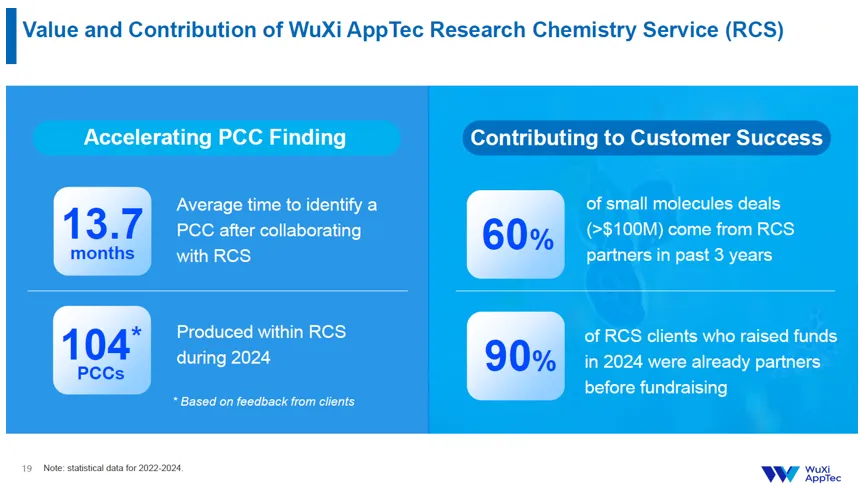
“This means that, even just in the delivery of the PCC stage, we can help clients save about 40% of the time,” says Wu.
Behind that compression lies not only technological innovation but also the structural power of WuXi AppTec’s integrated CRDMO model: the company’s signature platform linking Research (R), Development (D), and Manufacturing (M) in a single continuum.
At the Research end, chemists work shoulder-to-shoulder with biologists, pharmacologists, and safety experts, creating a one-stop system that supports the entire early discovery stage. Those same molecules then flow seamlessly downstream into the Development and Manufacturing phases, maintaining continuity, data integrity, and speed.
“In the past, chemists worked mainly within chemistry,” Wu says. “Now, every project demands collaboration across biology, analytics, and process development. Only by integrating all these disciplines can we truly support clients from discovery through manufacturing.”
That approach has built loyalty measured not in quarters but in decades. WuXi AppTec’s chemistry teams now serve thousands of clients worldwide: 980 partnerships lasting more than five years, 280 beyond ten, and over a dozen exceeding twenty, spanning nearly the entire twenty-five-year history of the company itself.
The Weight of 430,000+ Molecules
According to Q3 2025 WuXi AppTec financial results published in October, 2025, from October 2024 to September 2025, the RCS teams synthesized more than 430,000 compounds.
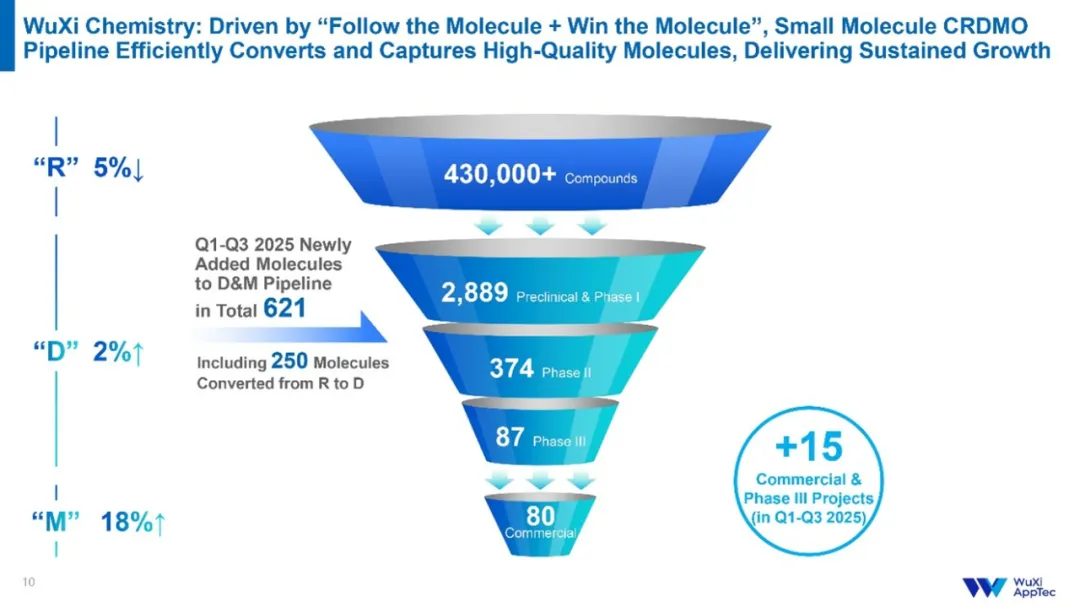
Each compound is a sliver of possibility, part of a vast molecular library that feeds the global drug-discovery pipeline. In 2024 alone, 104 of those molecules advanced to preclinical candidate status, the point where an idea becomes a viable contender for a future medicine. For Wu, each one carries the potential to change a patient’s life.
What makes those numbers more remarkable is the rising difficulty of the task. “According to the classic Lipinski's Rule of Five, a molecule’s weight shouldn’t exceed 500 daltons,” Wu says. “Now, many of the new ones are over 1,000.” The heavier the molecule, the trickier the synthesis. “You can think of them as ten-story buildings compared to the five-story ones we used to build,” he adds.
Inside the labs, that complexity shows on the faces of the chemists. “Sometimes I see colleagues with furrowed brows,” Wu says. “They’re working on compounds no one has ever made before.” Each experiment is a small act of exploration, a climb toward an unexplored summit.
Someone, after all, must be the first to chart the way. And for Wu’s teams, those countless trials and the endless iterations are their daily climbs.
Wu often reflects on his early years as a Ph.D. student, when synthesizing a few hundred compounds over several years was considered a major accomplishment. Today, his teams achieve something far greater.
“The 440,000+ compounds we deliver each year are not just numbers,” Wu says. “They are our promise to clients, proof of how far we can push the boundaries of chemistry.”
Always Ready for the Next Challenge
In 2016, Wu and his team encountered a new class of molecules that looked nothing like the compounds they had worked with before: targeted protein degraders, large, intricate structures that defied convention.
“It was the first time we had ever seen molecules so big, with such unusual structures,” Wu recalled. “None of us had handled this kind of chemistry before. But instead of hesitating, everyone leaned in. The challenge itself became the motivation.”
At the time, targeted protein degradation was more theory than mainstream science. Few companies had the infrastructure or experience to handle such complexity. WuXi AppTec moved quickly, building an integrated platform to support this new modality from discovery through development.
Ten years later, the team has synthesized more than 188,000 complex degraders for its clients. Over 70 have advanced to preclinical candidate status, and more than ten are already in late-stage development.
“It’s incredibly rewarding to see our work help new therapies reach the clinic,” Wu says. “That’s why we do this.”
But his teams don’t stop at the molecular level. They rethink how molecules are made, continually adopting and advancing frontier technologies such as flow chemistry.
Wu explained that in a traditional setting, scaling up a chemical reaction can be treacherous: a process that works perfectly on a 10-milligram scale might collapse entirely at a kilogram.
Flow chemistry changes that. Instead of a single static batch, the reaction happens inside a continuously moving stream. “It’s like a chemical process flowing through a pipe,” Wu says.
In this innovative setup, conditions remain steady; output simply depends on how long the flow runs. This design minimizes the risk of failure during scale-up and allows scientists to adjust conditions in real time. “From milligrams to kilograms, there’s no sharp boundary. It’s just continuous chemistry,” Wu explains.
“If the reaction conditions at the Research stage can be seamlessly scaled to the Development and Manufacturing stages, it can save clients enormous time and effort,” he adds.
By combining flow chemistry with other emerging technologies like photochemistry, the team can effectively break through technical bottlenecks and improve synthetic efficiency.
According to Wu, it is estimated that more than 90 percent of partners have benefited from this “advanced synthesis toolbox.”
Yet for Wu, the point isn’t speed for speed’s sake, it’s readiness. “We can’t solve new problems with old methods,” he says. “So we keep learning, keep experimenting, and stay open to what’s next. The real challenge is to be always ready, long before the industry even knows it needs you.”
The Meaning of Speed
“Chemistry can be repetitive and full of failure,” Wu acknowledged. “But behind each molecule is the same question: What if this one works?”
One experience made that question deeply personal. Years after Wu and his colleagues helped synthesize a small molecule compound for a client, they read the results in a published paper: the drug, used to treat lung cancer, had shrunk tumors in some patients dramatically within weeks, no advanced medical degree was needed to tell the difference.
For the chemists who had spent months optimizing reactions and purification steps, the results were transformative. “They realized that the compound they had worked so hard to create was now helping real patients,” Wu says. “It was a profound reminder of why we do what we do.”
That connection from a molecule’s first synthesis to a patient’s recovery captures the quiet significance of their work. Each success rests on thousands of unseen experiments, each failure paving the way for future breakthroughs. Together, they represent a collective effort to make new medicines possible.