
%20-%20http://www.bohemiancoding.com/sketch%20--%3e%3ctitle%3eIcon/Menu%3c/title%3e%3cdesc%3eCreated%20with%20Sketch.%3c/desc%3e%3cdefs%3e%3cpolygon%20id='path-1'%20points='0.0005%200.646%2022.386%200.646%2022.386%203.1455%200.0005%203.1455'%3e%3c/polygon%3e%3cpolygon%20id='path-3'%20points='0.0005%200.9341%2022.386%200.9341%2022.386%203.4341%200.0005%203.4341'%3e%3c/polygon%3e%3cpolygon%20id='path-5'%20points='0.0005%200.5%2022.386%200.5%2022.386%203%200.0005%203'%3e%3c/polygon%3e%3c/defs%3e%3cg%20id='Symbols'%20stroke='none'%20stroke-width='1'%20fill='none'%20fill-rule='evenodd'%3e%3cg%20id='Icon/Menu'%3e%3cg%20id='Group-10-Copy'%20transform='translate(3.800000,%205.300000)'%3e%3cg%20id='Group-3'%20transform='translate(0.000000,%200.354500)'%3e%3cmask%20id='mask-2'%20fill='white'%3e%3cuse%20xlink:href='%23path-1'%3e%3c/use%3e%3c/mask%3e%3cg%20id='Clip-2'%3e%3c/g%3e%3cpath%20d='M22.3865,2.6455%20C22.3865,2.9205%2022.1615,3.1455%2021.8865,3.1455%20L0.5005,3.1455%20C0.2245,3.1455%200.0005,2.9205%200.0005,2.6455%20L0.0005,1.1455%20C0.0005,0.8705%200.2245,0.6455%200.5005,0.6455%20L21.8865,0.6455%20C22.1615,0.6455%2022.3865,0.8705%2022.3865,1.1455%20L22.3865,2.6455%20Z'%20id='Fill-1'%20fill='%23FFFFFF'%20mask='url(%23mask-2)'%3e%3c/path%3e%3c/g%3e%3cg%20id='Group-6'%20transform='translate(0.000000,%207.354500)'%3e%3cmask%20id='mask-4'%20fill='white'%3e%3cuse%20xlink:href='%23path-3'%3e%3c/use%3e%3c/mask%3e%3cg%20id='Clip-5'%3e%3c/g%3e%3cpath%20d='M22.3865,2.9341%20C22.3865,3.2091%2022.1615,3.4341%2021.8865,3.4341%20L0.5005,3.4341%20C0.2245,3.4341%200.0005,3.2091%200.0005,2.9341%20L0.0005,1.4341%20C0.0005,1.1591%200.2245,0.9341%200.5005,0.9341%20L21.8865,0.9341%20C22.1615,0.9341%2022.3865,1.1591%2022.3865,1.4341%20L22.3865,2.9341%20Z'%20id='Fill-4'%20fill='%23FFFFFF'%20mask='url(%23mask-4)'%3e%3c/path%3e%3c/g%3e%3cg%20id='Group-9'%20transform='translate(0.000000,%2015.354500)'%3e%3cmask%20id='mask-6'%20fill='white'%3e%3cuse%20xlink:href='%23path-5'%3e%3c/use%3e%3c/mask%3e%3cg%20id='Clip-8'%3e%3c/g%3e%3cpath%20d='M22.3865,2.5%20C22.3865,2.775%2022.1615,3%2021.8865,3%20L0.5005,3%20C0.2245,3%200.0005,2.775%200.0005,2.5%20L0.0005,1%20C0.0005,0.725%200.2245,0.5%200.5005,0.5%20L21.8865,0.5%20C22.1615,0.5%2022.3865,0.725%2022.3865,1%20L22.3865,2.5%20Z'%20id='Fill-7'%20fill='%23FFFFFF'%20mask='url(%23mask-6)'%3e%3c/path%3e%3c/g%3e%3c/g%3e%3c/g%3e%3c/g%3e%3c/svg%3e)
'%20fill='%23fff'%20fill-rule='nonzero'%3e%3cg%20id='icon/fold'%20transform='translate(240.000000,%20272.000000)'%3e%3cpath%20d='M11.5,2.3%20C6.4216,2.3%202.3,6.4216%202.3,11.5%20C2.3,16.5784%206.4216,20.7%2011.5,20.7%20C16.5784,20.7%2020.7,16.5784%2020.7,11.5%20C20.7,6.4216%2016.5784,2.3%2011.5,2.3%20Z%20M10.58,18.7956%20C6.946,18.3448%204.14,15.2536%204.14,11.5%20C4.14,10.9296%204.2136,10.3868%204.3332,9.8532%20L8.74,14.26%20L8.74,15.18%20C8.74,16.192%209.568,17.02%2010.58,17.02%20L10.58,18.7956%20Z%20M16.928,16.4588%20C16.6888,15.7136%2016.008,15.18%2015.18,15.18%20L14.26,15.18%20L14.26,12.42%20C14.26,11.914%2013.846,11.5%2013.34,11.5%20L7.82,11.5%20L7.82,9.66%20L9.66,9.66%20C10.166,9.66%2010.58,9.246%2010.58,8.74%20L10.58,6.9%20L12.42,6.9%20C13.432,6.9%2014.26,6.072%2014.26,5.06%20L14.26,4.6828%20C16.9556,5.7776%2018.86,8.418%2018.86,11.5%20C18.86,13.4136%2018.124,15.1524%2016.928,16.4588%20Z'%20id='形状'%3e%3c/path%3e%3c/g%3e%3c/g%3e%3c/g%3e%3c/svg%3e)
Press Releases

GEN | How Integrating Chemistry and Biology Reshapes Early Drug Development
2026/05/05
At the American Association for Cancer Research (AACR) Annual Meeting, the spotlight often reflects the rapid pace of cancer science: new targets, emerging biology, and evolving therapeutic approaches. But the real challenge lies in translating these scientific advances into viable drug candidates. Before this year’s meeting, GEN spoke with Tao Guo, Ph.D., Senior Vice President, Research Chemistry Services, Integrated Program Management at WuXi AppTec, about emerging trends and how integrated approaches are reshaping early discovery.
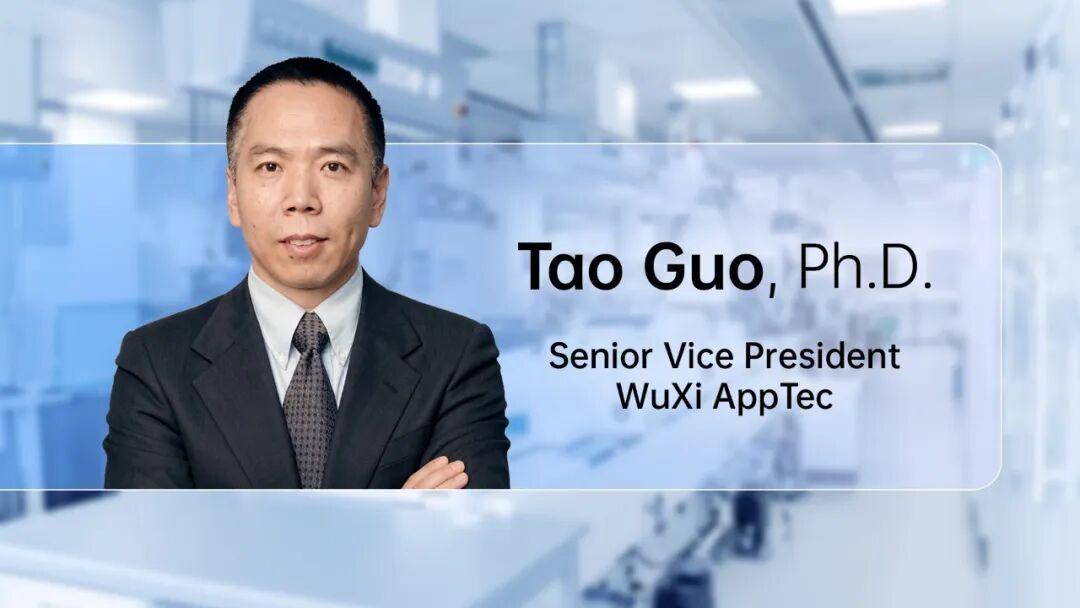
GEN: What stands out to you on the discovery side this year?
Tao Guo: Three areas stand out. First, targeted protein degradation (TPD) is expanding beyond traditional E3 ligases like CRBN and VHL into newer systems such as DCAF15 and KEAP1. Second, synthetic lethality continues to evolve beyond PARP inhibitors, with targets like PRMT5 and WRN showing broader potential. Third, antibody-drug conjugates (ADCs) are advancing rapidly, with innovations in payloads and linkers, as well as emerging approaches like degrader-antibody conjugates that combine modalities.
These scientific advances have also influenced early-stage discovery thinking. Instead of focusing on a single target, teams now consider entire pathways such as MAPK or PI3K and anticipate adaptive resistance mechanisms driven by tumor biology. At the same time, success is no longer defined by potency alone. There is greater emphasis on binding kinetics, target engagement duration, and early integration of biomarker strategies to improve clinical translation.
Image source:123RF

GEN: How has the role of discovery chemistry evolved to support these changes?
Tao Guo: Discovery chemistry has shifted from a linear, reactive role to a highly integrated one. Medicinal chemists are now involved from the beginning, working alongside biologists in target hypothesis, validation, and experimental design. We are also moving from reactive synthesis to predictive design, supported by computational tools and integrated datasets. “Direct-to-Biology” workflows enable faster design–make–test–analyze cycles, linking synthesis and biological testing in real time. As a result, chemistry and biology are no longer separate steps but part of a single, iterative process focused on decision-making and outcomes.
GEN: Do you still see any challenges? How is WuXi AppTec addressing them?
Tao Guo: A key challenge is translatability. Compounds that perform well in vitro often fail in cellular or in vivo systems, especially with complex modalities like degraders or ADC payloads. At the same time, increasing assay complexity generates large datasets that are difficult to interpret efficiently.
At WuXi AppTec, we address this by integrating chemistry, biology, and testing early in the discovery process. This includes designing higher-quality libraries, applying multi-parameter optimization beyond potency, and enabling rapid triage of chemical series. By combining real-time data integration with iterative workflows, we can enable our customers to make earlier, more informed go or no-go decisions, thereby reducing downstream risk and improving overall efficiency.
GEN: Where do smaller biotech companies face the biggest gaps in early discovery?
Tao Guo: The biggest gap is access to integrated infrastructure. Many smaller biotechs have strong biology or design expertise but lack capabilities in chemistry, testing, and coordinated workflows, which limit both speed and scale.
Integrated platforms can help bridge this gap. By providing end-to-end support, WuXi AppTec can help our customers’ programs move more efficiently from target concept to preclinical candidate, allowing smaller teams to focus on scientific direction while accelerating execution.
GEN: Looking ahead, what shifts do you expect in discovery chemistry?
Tao Guo: Discovery chemistry is becoming more modality-agnostic, spanning small molecules, degraders, and conjugates. New technologies such as flow chemistry, high-throughput experimentation, and automation are expanding access to novel chemical space and improving speed.
Equally important, discovery is becoming more closely aligned with development and manufacturing. Within an integrated CRDMO model, teams can incorporate considerations such as process feasibility and scalability earlier in design, reducing handoff friction and accelerating progression.
Overall, discovery is evolving from a compound-focused discipline to an outcome-focused one. Success increasingly depends on how well capabilities are integrated to translate scientific advances into medicines that can reach patients.
Click here to read the original news.